|
|
|
|
|
|
|
|

|
Don't Miss Any Special Deals - Sign Up To Our Newsletter!
| |||||||||||||||
| CLICK HERE FOR A FULL LIST OF ALL NICOLAS TRUDGIAN PRINTS BY TITLE |
|
No.617 Sqn
Country : UK
Founded : 23rd March 1943
Codes : , AJ, YZ, KC,
Apres mois, le deluge - After me, the flood
| Nicolas Trudgian No.617 Sqn Aviation Art Prints Aviation Art |
|
|
|
|
| Text for the above items : |
Breaching the Dams by Nicolas Trudgian. The Mohne Dam gives way as David Maltbys Lancaster releases its bomb to deliver the coup de grace on the night of 16th / 17th May 1943. Guy Gibson, nearest, and Mick Martin, having already dropped their bombs, make dummy runs with lights on to draw enemy fire. |
Sinking the Tirpitz by Nicolas Trudgian. Throughout four long years of war Allied air and naval forces endeavoured to sink the German battleship Tirpitz. The mighty warship was a constant threat to Allied shipping, even while lying at anchor in her lair among the fjords of Norway. Her very presence demanded constant attention and hampered all naval decision making till she was sunk at the end of 1944. Without so much as weighing anchor, Tirpitz could disrupt the north Atlantic convoys by tying up urgently needed escort vessels in readiness in case she made a run for the open sea. Churchill was exasperated and called upon RAF Bomber Command to make a decisive bid to finish her off once and for all. On November 12, 1944 Lancasters of Number 9 and 617 Squadrons set forth towards the Norwegian fjord of Tromso where Tirpitz lay at anchor surrounded by a web of protective submarine nets. Armed with the 12,000lb Tallboy bomb devised by Barnes Wallis, the Lancaster crews arrived in clear skies overhead the fjord to see the great battleship sharply contrasted against the still deep waters some 10,000ft below. As flak from the ships heavy armament burst all around them, one by one the 31 Lancasters rolled in for the attack. In a matter of three minutes the devastating aerial bombardment was completed, and eleven minutes later, her port side ripped open, the Tirpitz capsized and sank. The Coup de Grace was complete. Published 2000. |
Bomber Force by Nicolas Trudgian. The tension is electric; slowly they climb to circle the airfield while the entire squadron gets airborne. Below, the countryside reverberates with the sound of roaring Merlin engines. RAF Lancaster bombers of 617 Squadron. |
Homeward Bound by Nicolas Trudgian. No single raid during World War Two has attracted more discussion, analysis, features, books, interviews, or been the subject of more films, documentaries, and TV programmes than the famous attack mounted by the RAFs 617 Squadron upon the mighty hydroelectric dams in Westphalia, on the night of 16/17 May, 1943. Led by Wing Commander Guy Gibson, nineteen specially adapted Lancaster bombers, manned by 133 aircrew, culminated months of secret training when they made one of the most audacious raids of the war. Flying at tree-top height in darkness, and doing their best to avoid electricity pylons and other obstructions, they navigated their way deep into occupied territory. Their targets were the huge Mohne, Sorpe, Ennepe, and Eder Dams that powered Germanys huge industrial factories in the heartland of the Rhur. Each bomber had to avoid enemy flak and fighters en route, locate their target, descend to precisely 60 feet above the water then, in the face of a barrage of anti-aircraft fire, release their single unique 10,000 lb hydrostatic bomb at exactly the right moment. There was no margin for error, and there was no place for faint hearts. Eight of the crews that left RAF Scampton that night were never to return. Of the fifty-six aircrew on board only two survived. Though nearly half the skilled crews that made up 617 squadron were lost, they recorded one of the most successful and daring air raids of the war- a costly endeavour, but one that has become legend in the annals of aerial warfare. Nicolas Trudgians emotive painting Homeward Bound depicts Dave Shannons Lancaster AJ-L, dodging the searchlights low over the Dutch landscape, as he returns from the Eder Dam following the part he and his crew played in the famous raid on that moonlight night in May, 1943. Published 2000. |
| No.617 Sqn RAF Aircraft details |
 Lancaster Manufacturer : Avro Built : 7377 | Lancaster The Avro Lancaster arose from the avro Manchester and the first prototype Lancaster was a converted Manchester with four engines. The Lancaster was first flown in January 1941, and started operations in March 1942. By March 1945 The Royal Air Force had 56 squadrons of Lancasters with the first squadron equipped being No.44 Squadron. During World War Two the Avro Lancaster flew 156,000 sorties and dropped 618,378 tonnes of bombs between 1942 and 1945. Lancaster Bomberss took part in the devastating round-the-clock raids on Hamburg during Air Marshall Harris' "Operation Gomorrah" in July 1943. Just 35 Lancasters completed more than 100 successful operations each, and 3,249 were lost in action. The most successful survivor completed 139 operations, and the Lancaster was scrapped after the war in 1947. A few Lancasters were converted into tankers and the two tanker aircraft were joined by another converted Lancaster and were used in the Berlin Airlift, achieving 757 tanker sorties. A famous Lancaster bombing raid was the 1943 mission, codenamed Operation Chastise, to destroy the dams of the Ruhr Valley. The operation was carried out by 617 Squadron in modified Mk IIIs carrying special drum shaped bouncing bombs designed by Barnes Wallis. Also famous was a series of Lancaster attacks using Tallboy bombs against the German battleship Tirpitz, which first disabled and later sank the ship. The Lancaster bomber was the basis of the new Avro Lincoln bomber, initially known as the Lancaster IV and Lancaster V. (Becoming Lincoln B1 and B2 respectively.) Their Lancastrian airliner was also based on the Lancaster but was not very successful. Other developments were the Avro York and the successful Shackleton which continued in airborne early warning service up to 1992. |
 Mosquito Manufacturer : De Havilland Built : 7781 | Mosquito Used as a night fighter, fighter bomber, bomber and Photo-reconnaissance, with a crew of two, Maximum speed was 425 mph, at 30,300 feet, 380mph at 17,000ft. and a ceiling of 36,000feet, maximum range 3,500 miles. the Mosquito was armed with four 20mm Hospano cannon in belly and four .303 inch browning machine guns in nose. Coastal strike aircraft had eight 3-inch Rockets under the wings, and one 57mm shell gun in belly. The Mossie at it was known made its first flight on 25th November 1940, and the mosquito made its first operational flight for the Royal Air Force as a reconnaissance unit based at Benson. In early 1942, a modified version (mark II) operated as a night fighter with 157 and 23 squadron's. In April 1943 the first De Haviland Mosquito saw service in the Far east and in 1944 The Mosquito was used at Coastal Command in its strike wings. Bomber Commands offensive against Germany saw many Mosquitos, used as photo Reconnaissance aircraft, Fighter Escorts, and Path Finders. The Mosquito stayed in service with the Royal Air Force until 1955. and a total of 7781 mosquito's were built. |
| No.617 Sqn RAF Pilot and aircrew signature details |
  Squadron Leader Ken Brown CGM RCAF Our estimated value of this signature : £85 Died : 2002 | Squadron Leader Ken Brown CGM RCAF Born 20th August 1920. Joined the Canadian Air Force in 1941, and joined No.617 Sqn in 1943. Pilot and Captain of Lancaster AJ-F, he attacked the Sorpe Dam. Ken Brown died 23rd December 2002. |
  Flight Lieutenant George Chalmers DFC DFM Our estimated value of this signature : £65 Died : 2002 | Flight Lieutenant George Chalmers DFC DFM George Alexander Chalmers was born on February 12 1921 at Peterhead in Scotland. He was educated at Aberdeen Academy before working briefly at a local Crosse & Blackwell factory and joining the RAF as a boy entrant. After boy's service and qualifying as a wireless operator and air-gunner, Chalmer joined the RAF in 1938. Geogre Chalmers was posted to No 10, a two-engine Whitley bomber squadron at Dishforth, Yorkshire, from where he took part in leaflet-dropping operations over Germany after the outbreak of war. In August 1940 Chalmers transferred to No 7, the RAF's first four-engine Stirling bomber squadron which was operating from Leeming. There followed a spell with No 35, a four-engine Halifax bomber squadron, with which Chalmers was fortunate to survive an attack on the battle cruiser Scharnhorst at La Rochelle - his captain managed to make base despite being severely wounded and piloting a badly-damaged aircraft. When he joined 617 Squadron he was a Flight Sergeant and served as wireless operator on Lancaster AJ-O during the Dambusters raid which was piloted by Bill Townsend. Awarded the DFM for his part in the attack on the Ennepe Dam he was commissioned a few months later and awarded the DFC after 65 operations. In 1946 Chalmers was granted an extended service commission, and served in No 617 and No 12 Squadrons until 1950, when he was posted to No 38, a Lancaster squadron in the Middle East. He was released as a flight lieutenant in 1954, and served in the Reserve until 1961. Meanwhile, he had joined the civil service at Harrogate, where he worked for the Ministry of Defence dealing with the RAF's technical requirements. In this period his advice was much valued in the sphere of flight refuelling. On his retirement from the MoD in 1984, the company Flight Refuelling hosted a farewell party for him at which he was hailed as an expert in specialised spares procurement, especially in relation to a refuelling system of outstanding value used by the RAF in the Falklands conflict. Sadly, George Chalmers passed away in August 2002 aged 81. |
  Sergeant Raymond E. Grayston Our estimated value of this signature : £65 Died : 2010 | Sergeant Raymond E. Grayston Ray Grayston had been serving in 50 Squadron when he was posted to 617 Squadron in March 1943. The flight engineer of Les Knights Lancaster AJ-N, they attacked and successfully breached the Eder Dam, Ray was shot down on 16th September 1943, and was taken to Stalag Luft III as a POW. Sadly, we have learned that Ray Grayston passed away on 15th April 2010. |
Squadron Leader Malcolm Mac Hamilton DFC* Our estimated value of this signature : £60 Died : 2008 | Squadron Leader Malcolm Mac Hamilton DFC* After joining Coastal Command in 1943, Mac converted to Lancasters, and was posted to Bomber Command, joining 619 Squadron at Woodall Spa for his first tour. Here he flew sorties mainly to Berlin andthe Ruhr. For his second tour he joined Cheshires 617 Squadron, again at Woodall Spa, where he flew precision operations, including the raids on the Saumur rail tunnel, the U-boat pens, V1 sites and V2 rocket bases, and the raids against the German battleship Tirpitz. He died in April 2008. |
  Squadron Leader Tony Iveson DFC Our estimated value of this signature : £45 Died : 2013 | Squadron Leader Tony Iveson DFC Tony Iveson fought in the Battle of Britain with RAF Fighter Command, as a Sergeant pilot, joining 616 Squadron at Kenley flying Spitfires on 2 September 1940. On the 16th of September, he was forced to ditch into the sea after running out of fuel following a pursuit of a Ju88 bomber. His Spitfire L1036 ditched 20 miles off Cromer in Norfolk, and he was picked up by an MTB. He joined No.92 Sqn the following month. Commissioned in 1942, Tony undertook his second tour transferring to RAF Bomber Command, where he was selected to join the famous 617 Squadron, flying Lancasters. He took part in most of 617 Squadrons high precision operations, including all three sorties against the German battleship Tirpitz, and went on to become one of the most respected pilots in the squadron. He died on 5th November 2013. |
  Flight Lieutenant Edward Johnson Our estimated value of this signature : £65 Died : 2002 | Flight Lieutenant Edward Johnson He joined the RAFVR early in the war, serving with 50 and 106 Squadrons. When he joined 617 Squadron in 1943 he was the bomb aimer on Lancaster AJ-N piloted by Les Knight on the Dambusters raid. During that raid they first attacked the Mohne Dam and then went on to attack and actually breach the Eder Dam, for which he was awarded the DFC. Later in 1943 he was shot down but evaded capture and during a two month journey returned to England via Holland, France, Spain and Gibraltar. Sadly, Edward Johnson died 1st October 2002. |
  Squadron Leader George L. Johnson DFM Our estimated value of this signature : £45 Died : 2022 | Squadron Leader George L. Johnson DFM Joining the RAF in 1940, George Johnson served with 97 Squadron before joining 617 Squadron. Bomb aimer on American Joe McCarthys Lancaster AJ-T, they attacked the Sorpe Dam, for which he was awarded the DFM. Commissioned a few months later, George retired from the RAF in 1962. The last surviving Dambuster, he died aged 101 on 7th December 2022. |
 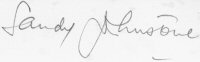 Air Vice Marshal Sandy Johnstone CB DFC AE DL Our estimated value of this signature : £60 Died : 2000 | Air Vice Marshal Sandy Johnstone CB DFC AE DL Early in 1938, Alexander Vallance Riddell Johnstone, known as Sandy, was a civilian navigation instructor at Scottish Aviation, moving later to the Civil Air Navigation School at Prestwick. In August 1939 he was called to full-time service with 602 Squadron. After some Spitfire engagements off the Scottish coast, he received command of 602 - he was still only 24 - and led it south to the tiny airfield at West Hampnett, in West Sussex, where it was stationed throughout the Battle of Britain. Sandy was in command of no. 602 squadron during the critical days of the Battle of Britain, flying with the squadron before the war though to 1941, when he was posted to the Middle east, he also served with 229 and 249 squadrons in Malta during the Islands most fateful days of the war. Sandy became a successful author and resided near Ipswich in Suffolk. Sandy Johnstone died 13th December 2000, aged 84. |
Squadron Leader Terry Kearns Our estimated value of this signature : £60 Died : 1996 | Squadron Leader Terry Kearns New Zealander Derek Terry Kearns joined the RNZAF in December 1940, transferring to England in 1941 to join 75 (NZ) Squadron, flying Wellingtons. In 1942 he took part in the first 1000 bomber raids before joining 156 Squadron Pathfinders. After a period as an instructor, he joined 617 Squadron at Warboys on operations. He flew the Mosquito FBVI on precision low-level target marking throughout 1944. He took part in most of 617s major operations, including raids on the Samur rail tunnel, and the V1 rocket sites. He died in 1996 aged 75. |
  Flt Lieutenant Bob Knights DSO, DFC Our estimated value of this signature : £45 Died : 2004 | Flt Lieutenant Bob Knights DSO, DFC A member of the elite 617 Dambusters squadron, Bob Knights had a key role on the night before D-Day. With the rest of the squadron he flew on Operation Taxable which simulated the approach of the invasion across the Pas de Calais by dropping metal strips of window to a very precise pattern. The enemy was completely deceived and kept most of their best troops on the wrong side of the Seine. Bob Knights had already flown a full operational tour with 619 Squadron Lancasters, including eight trips to Berlin, before volunteering for 617 Squadron. Under Cheshire he flew on some of the squadrons most challenging precision operations and later under Willie Tait took part in the attack that finally destroyed the Tirpitz. Seconded to BOAC in December 1944 he stayed with the airline after the war for a 30 year long career. He died 4th December 2004. |
 Flight Lieutenant Joe C McCarthy Our estimated value of this signature : £70 Died : 1998 | Flight Lieutenant Joe C McCarthy In March 1943, a special Royal Air Force (RAF) unit, 617 Squadron, was created to try a new tactic--low altitude bombing using deep penetration bombs that weighed from 9,500 to 22,000 pounds. Their first targets were three dams in the Ruhr industrial area of western Germany: the Mohne, the Eder, and the Sorpe. These dams supplied water for Ruhr steel mills and hydroelectric power. Twenty Avro Lancaster bombers were specially modified for this mission to carry a new, rotating skip bomb that would bounce across the lake, sink, and then explode at the base of the dam. So secret was the dambusting mission, that the pilots and navigators were briefed only the day before as to the actual targets. The three dams were struck, and two were breached, on the night of 16 May 1943. 'Joe' McCarthy, from Long Island, New York, was an original member of 617 Squadron. He joined the Royal Canadian Air Force (RCAF) in 1941 and soon transferred with his crew to RAF Bomber Command. From 1941 until late 1944, he flew the Hampden, Manchester, Lancaster, and Mosquito bombers and compiled a total of 80 combat missions. As Officer Commanding, German Aircraft Flight, he tested and flew over 20 different German aircraft, which had been taken from captured German airfields back to Farnborough for extensive engineering evaluation. During this period, McCarthy flew the first British operational jet, the Meteor, and the experimental Windsor bomber. Upon returning to Edmonton, Canada, he continued flight testing a variety of aircraft for cold weather operations as well as the experimental Canadian flying wing. During 28 years in the RCAF, he flew 64 different British, American, German, and Canadian aircraft. Later assignments included base executive officer for an F-86 NATO installation in France; Commander, Flying Training School, RCAF Station Penhold, Canada; and Commanding Officer of the 407 Maritime Squadron, flying the P2V Neptune. From 1961 to 1962, he was Chief of Air Operations for the United Nations' forces in the Congo, and from 1963 to 1966, worked in plans and policy for CINCLANT/CINCLANTFLT. Wing Commander McCarthy's final assignment was as base operations officer for two maritime squadrons flying the Argus antisubmarine warfare aircraft in Nova Scotia. He retired from the RCAF in 1969 and, after a second career in real estate, fully retired in 1986. Passed away 6th September 1998. |
  Flight Sergeant Grant S McDonald RCAF Our estimated value of this signature : £45 Died : 2012 | Flight Sergeant Grant S McDonald RCAF Grant McDonald was the rear gunner on Lancaster AJ-F flown by Ken Brown. On the way to the Ruhr, the gunners shot up and damaged three trains in an eventful trip before reaching the Sorpe Dam. Sadly, we have learned that Grant S McDonald passed away in May 2012. |
 Sergeant Stefan Oancia DFM Our estimated value of this signature : £60 Died : 1999 | Sergeant Stefan Oancia DFM Born in Stonehenge, Saskatchewan, Canada in 1923, Sgt. Stefan Oancia enlisted in the RCAF on the 1st ofAugust 1941. Trained at No.2 ITS (graduated 4 December 1941), No.3 AOS (graduated 13 March 1942), No.2 BGS (graduated 25 April 1942) and No.1 ANS (graduated 25 May 1942) and was the bomb aimer on F/Sgt. Kenneth W Brown's Lancaster ( AJ-F Freddie). He survived the raid and the war and was awarded the DFM, presented at Buckingham Palace on 22nd June 1943. Sadly he passed away on the 15th of May 1999. |
 Flying Officer Dave Rodger Our estimated value of this signature : £60 Died : 2004 | Flying Officer Dave Rodger Born in Sault Ste marie, Ontario on February 23rd 1918, he son of a Scots carpenter, David Rodger was an avid collector of aeroplane magazines as a boy, that began his interest in flying. David Roger went to the local technical school, then worked for Algoma Steel while serving in the Canadian Militia. Rodger joined the Royal Canadian Air Force in October 1941 and trained as an air gunner before being commissioned as pilot officer, and then arriving in England in 1942. David Rodger converted to Lancaster bombers, and joined No 97 Squadron at Woodhall Spa near Lincoln, and it was here he teamed up with McCarthy. During their time with 97 squadron they attacked the main industrial cities on the Rhur and also Hamburg and Berlin. By the time they joined No 617 Squadron, they were recognised as an experienced crew. Rodger and McCarthy had already completed more than 20 bombing raids together when they were selected to join No 617 Squadron, forming at RAF Scampton in March 1943 under the command of Wing Commander Guy Gibson. David Rodger was the rear gunner in Big Joe McCarthy's Lancaster, which attacked the Sorpe Dam during Operation Chastise, the Dam Buster raid of May 16th 1943. On the night of the raid their aircraft was unservicable due to an engine problem, so they took the reserve aircraft which had been fitted with the upkeep bouncing bomb, but not had time to be fitted with the crucial spoptlights which were used to keep the aircraft at the height of 60 feet. As McCarthy took the bomber across the coast at 100ft, Rodger, in the rear turret, was soon in action trying to douse the searchlights before having a lively exchange with a light flak gun. By the time they arrived at the Sorpe, McCarthy's men were the only survivors of the team charged with attacking the dam, which was shrouded in mist as they arrived. With a tall church spire on the approach and a hill to be avoided after the attack, McCarthy had great difficulty getting into position to drop the mine. The lack of the height-finding spotlights made the job almost impossible. The crew made nine dummy attacks before releasing their weapon accurately at last. But the force of the explosion was insufficient to breach the earth dam, and McCarthy and his men set course for base. After the success of the Dam raids 617 squadron now under the command of Wing Commander Leonard Cheshire specialised in the attack of pinpoint targets, and Cheshire and his four senior crews from the dam buster raid developed daring and accurate low-level target-marking techniques. Rodger was appointed the gunnery leader of the squadron in September. Rodger then attacked targets in Italy, and made pinpoint raids against viaducts and the huge concrete constructions associated with the V-1 rocket programme in the Pas de Calais. In addition to their marker role, the Lancasters of No 617 carried the massive 12,000-ton Tallboy bomb, which was used to devastating effect against V-sites and railway tunnels. During the night of June 5 1944, 16 Lancasters of No 617 carried out a unique operation, dropping a dense screen of 'window' (foil strips) which advanced slowly across the Channel to simulate a large convoy of ships approaching the French coast between Boulogne and Le Havre, north of the real invasion area. After 14 months on No 617, McCarthy and his crew were finally rested in July 1944. Rodger, who had flown 50 bombing operations, including 24 with No 617, was awarded the DFC for his calm resolution in the face of the heaviest opposition, which has been an inspiration to his crew. Rodger returned to Canada in September 1944, where he married, and was released from the RCAF the following year. He returned to work at Algoma Steel, where he became a superintendent. Always a keen outdoorsman, he loved fishing and played his last game of ice hockey at 84. David Rodger died on September 1st 2004 in Canada aged 86. |
  Sergeant Frederick E. Sutherland RCAF Our estimated value of this signature : £45 Died : 2019 | Sergeant Frederick E. Sutherland RCAF Doc Sutherland was the front gunner on Les Knights Lancaster AJ-N that went to the Mohne Dam, and then successfully attacked and breached the Eder Dam. Shot down four months later, he managed to evade capture and escape back to England with the help of the Resistance movements, returning through Holland, France and Spain. He died on 21st of January 2019. |
  Group Captain J B Willie Tait DSO*** DFC* ADC Our estimated value of this signature : £40 Died : 2007 | Group Captain J B Willie Tait DSO*** DFC* ADC One of Bomber Commands most outstanding leaders, James Brian -Willie- Tait was one of only two RAF officers who had the distinction of being awarded three Bars to his DSO, as well as a DFC and Bar. On the night before D-Day Tait was the 5 Group Master Bomber directing from the air the massed attack by Lancasters on the German defences in the Cherbourg peninsula. By then Tait had already flown more than 100 bomber sorties with 51, 35, 10 and 78 Squadrons. A Cranwell-trained regular officer, he was very much in the Cheshire mould: quiet, bordering on the introspective. He was to go on to command the legendary 617 Dambusters Squadron and lead it on one of its most famous raids which finally destroyed the German battleship Tirpitz. In July 1944 when Leonard Cheshire was replaced by Wing Commander J B Willie Tait, 617 Squadron discovered that it had acquired a Commanding Officer very much in the Cheshire mould. Quiet, bordering on introspection, Tait, who was a Cranwell-trained regular officer, had already flown over 100 bombing operations with 51, 35, 10 and 78 Squadrons before joining 617. Tait had also received a DSO and bar and the DFC. He was 26. In the best traditions of 617 Squadron, Tait wasted no time in adapting to the Mustang and Mosquito for low level marking. He appointed two new Flight Commanders including Squadron Leader Tony Iveson DFC. Although involved in many of 617 Squadrons spectacular operations, Taits name is always associated with the destruction of the Tirpitz. An earlier attack on the ship by the squadron on 15th September 1944 had caused severe damage but Tirpitz was still afloat. On 29th October the Squadron was frustrated on the second attack by cloud over the target. The final attack was launched in daylight on 12th November 1944. Leading a mixed force of 617 and 9 Squadron Lancasters, Tait achieved complete surprise and had the satisfaction of seeing the Tirpitz destroyed at last. He had led all three attacks. On 28th December 1944 Tait received a third bar to his DSO, becoming one of only two RAF men to achieve this distinction. It coincided with his leaving 617 Squadron. Tait served in the post-war RAF, retiring as a Group Captain in 1966. He died 31st May 2007. |
 Sergeant Douglas E Webb Our estimated value of this signature : £65 Died : 2002 | Sergeant Douglas E Webb Mr Webb flew 27 missions as a gunner on Lancaster bombers before being selected in March 1943 for the 617 Squadron, which attacked the Mohne, Sorpe, and Eder dams - flooding the German war industry. He passed away in 2002. |
|
Contact Details |
|
Sign Up To Our Newsletter!
This website is owned by Cranston Fine Arts. Torwood House, Torwoodhill Road, Rhu, Helensburgh, Scotland, G848LE Contact: Tel: (+44) (0) 1436 820269. Email: cranstonorders -at- outlook.com |
 |


